Monday, 26 March 2012

Less Multilateral Aid for More Bilateral? (Bundestag Hearing, 28th March)

Germany’s Cooperation Minister Niebel wants to raise the share of bilateral to the detriment of the multilateral aid that Germany allocates in its budget. There has been pressure, all in favour of multilateral, that I ‘behave’ on 28th March in the Bundestag Hearing. But Minister Niebel has a point...Here is a short English version of my statement which will be in German.
Central Message
The desire for visibility, control and positive economic effects for the donor economy may militate for bilateral aid; positive scale effects in combining Know How and resources, better local presence and supplying regional and global public goods favour allocating a higher share of aid to multilateral delivery. Donor agencies that let a certain share of their aid budgets to the multilaterals are torn between giving up control and identifying with multilateral development goals. Germany can reduce that tension by either raising the bilateral share of its aid delivery or by proactive scripting of multilateral objectives. Germany should make active use of debate on the post-2015 follow-up to the Millennium Development Goals to align the new development goals clearly to specific multilateral institutions: The time for multilateral mission creep, overlap and dissociation of multilateral competence and liability is gone under a regime of tight aid budgets.
Some Facts
Table 1 compares Germany with its peer group – DAC donor average, France, United Kingdom and the United States on the amount and relative share of their multilateral aid budgets (in 2010).
Table 1 Multilateral Aid: A Comparison, 2010

Donors
multilateral aid, in bn $
in % donor’s total aid
DAC- average
37,88
26,8
Germany
 4,95
34,4
France
 5,22
36,3
United Kingdom
5,04
37,6
USA
3,77
12,1


Germany, the world’s third biggest provider of multilateral aid, is one of the very few donors to have guidelines to cap the share of its multilateral aid, at one third. Still, its multilateral share is quite above DAC average; the outlier is the USA, with a share of 12.1% of its aid budget devoted to multilaterals. Of Germany’s multilateral aid, almost 5 bn $, the EU received 3 bn, while an important (1 bn $) but shrinking share went to finance the World Bank. The UN system, regional development banks and vertical funds received the little that remained.
An important – and positive – trait of Germany’s multilateral aid is that it mostly finances core budgets – 93.4% compared to a DAC average of 71.3% (Source: OECD,  DAC Peer Review Germany 2010). The high share to the core budgets fosters transparency, control and incentive compatibility of the multilaterals. Earmarked contributions, by contrast, or cherry picking, undermine the governance of multilaterals by the principal, weaken transparency of the agent, and hence intensify the double delegation problem that characterizes principal-agent dilemma in governing multilaterals; moreover, cherry picking weakens core budgets and long-term work programmes.
Germany’s bilateral aid is typical project and programme related; it is supported by a unique set of implementation agencies such as the GIZ and by a bilateral development bank, the KfW. This set-up of German bilateral aid helps visibility and monitoring. Klasen (2011)[1] cites studies that show for one € of bilateral aid to translate into additional exports between 1.30 and 1.80 €. Not because of tied aid, but because bilateral aid improves bilateral political relationships that then act to stimulate bilateral trade links.
Table 2: Aid Quality 2009: Rankings of selected donors by CGDev

Donor
Efficiency
Poverty Or.
Governance Or
Institution Building
Administrative
Burden
Aid Tying
Germany
4
4
2
2
3
4
EU
2
3
1
3
2
3
World Bank
1
1
3
1
1
1
UN
3
2
4
4
3
1


Table 3: Aid Quality 2000-2007: Rankings of selected donors in empirical studies

Geber
Knack et al
Easterly/Putze
Roodman/CGD
Germany
2
2
4
EU
3
3
2
World Bank
1
1
1
UN
4
4
3

Source: Easterly, W., & Pfutze, T. (2008). Where Does the Money Go? Best and Worst Practices in Foreign Aid. Journal of Economic Perspectives, 22(2), pp. 29–52.; Knack, S., F.H. Rogers & N. Eubank (2011), Aid Quality and Donor Rankings. World Development ,39(11). 1907–1917; Roodman, D. (2006), An Index of Donor Performance, Center for Global Development Working Paper Number 67; Data set updated 2009.


On the basis of empirical studies (rather than DAC Peer Reviews that result from political interaction and lack credibility), Germany’s bilateral aid does not get good marks (see tables 2 and 3). If Germany wanted to maximize efficiency and effectiveness of its aid programme, it should increase the share for multilateral delivery, according to the empirical evidence cited. In particular, the World Bank should benefit from a higher allocation of multilateral aid. Note, however, that all authors involved in the empirical studies are presently or have been collaborators of the World Bank.
And this is not the end of story.  Fresh evidence provided by the Kiel Institut für Weltwirtschaft[2] found that neither the World Bank nor the EU had made any significant progress in translating the Paris Declaration into acts, namely through reducing overlaps with other donors or through specializing more on specific countries and sectors. Germany, by contrast, has made progress in producing a stronger sector and country focus.

Current Challenges to Multilateral Aid
To be sure, multilateral institutions[3] are better at supplying global public goods than bilaterals; but Germany’s bilateral development bank KfW, for example, finances green cities in China and contributes to global climate policy. And yes, multilateral lending has been argued by Rodrik to  better cope with information asymmetries and to more forcefully impose conditionality than bilateral lenders[4]; but the 1990s have revealed that it were the multilateral finance institutions that prolonged their defensive lending to the highly indebted poor countries much longer than the bilateral lenders.
Today, multilateral aid faces two challenges, and Germany and other donors have to cope with those challenges:
·         The rise of the emerging partners that prefer a bilateral mode of development cooperation with poor countries; cooperation is often tied and the financing is a mix of various forms of export buyer credit, FDI and other form of capital export, with some aid elements. Is it odd that the emerging partners seems often more effective in removing growth barriers in soft and hard infrastructures through bilateral acts than the many conferences by multilaterals that proclaim good governance rhetoric?
·         The multilateral donor chaos. The overlap, redundancy and mission creep of the multilaterals has not even been treated in the much-cited 2011 DIFD study Multilateral Aid Review. The current wooing (better: fighting) between multilateral institutions to be mandated by the G20 in the development area provides a vivid illustration. 280 multilateral institutions are currently ODA eligible: 60 UN agencies; four EU-Institutions; five IMF facilities; seven World Bank bodies; three of the WTO; 15 regional development banks and their funds; and 118 other multilateral institutions, among which the OECD Development Centre. Add to this list ca 60 international NGOs, 14 international PPPs, und four international networks. Source: OECD (2011), DAC Statistical Reporting Directive, DCD/DAC (2010)40/REV1.
MOPAN (Multilateral Organisations Performance Assessment Framework) does merely help, to defragment the multilateral donor chaos for the benefit of poor countries administrations stressed by multilateral donor missions and their bureaucracies. The assessments are based on qualitative, hence vague, impressions, avoid to compare between competing institutions. So they may help raise x-efficiency, not the allocative efficiency for dividing funds between institutions[5]. Multilateral fragmentation is not only a problem for poor partner countries, but also for the donor ministries. They face well-paid brainpower and some mighty multilateral organisations with staff that exceeds 10,000: the agent rules the principal…

Some Thoughts Going Forward
We lack the empirical evidence to inform policy choices on the allocation between bilateral and multilateral aid delivery channels. As for multilateral aid, we need
·         A serious mapping of multilateral aid with the aim to identify comparative advantages in servicing development goals, to create responsibilities for failure in reaching these goals, to streamline the multilateral landscape through agency closure and to establish a clear role assignment between institutions and development goals. The multilateral map should indicate to the G20 working groups how multilateral coordinate and where they are mandated.
·         Germany should strengthen its periodic governing and monitoring of multilateral institutions through proactive (rather than just reactive and personnel policy) blue prints and instructions. This should help reduce widely felt double delegation problems, align multilateral with German policy objectives and hence raise the acceptance of multilateral aid with German policymakers.
From the perspective of poor countries[6] the multilateral role assignment will have to observe the criteria a) development engagement and poverty orientation; b) flexible adjustment to the specific institutional and policy conditions in partner countries (instead of ideological zealotry); and c) how multilaterals can credibly convey that they support for policy ownership.


[1] Klasen, Stefan (2011), „Vom Unsinn der Lieferbindung in der EZ“, KfW, Meinungsforum Entwicklungspolitik, 19. October 2011. Compare the responce by  von Braun, Hans-Gert (2012), „Lieferbindung: Die Kritiker springen zu kurz!“, KfW, Meinungsforum Entwicklungspolitik, 10. February 2012.
[2] Nunnenkamp, Peter, Hannes Öhler und Rainer Thiele (2012), „In der Entwicklungszusammenarbeit fehlt die Koordination“, Ökonomenstimme, 21. März 2012.
[3] See Inge Kaul (1999), Global Public Goods; International Cooperation in the 21st Century, OUP.
[4] Rodrik, Dani (1995), „Why Is There Multilateral Lending?”, NBER Working Paper No.5160, June.
[5] Reisen, H (2008), “Ownership in the Multilateral Development Finance Non-System”, in: OECD, Financing Development 2008. DFID Multilateral Aid Review 2011 suffers from similar shortcomings.
[6] Wathne, Cecilie, & Edward Hedger (2010), “What Does an Effective Multilateral Donor Look like?”, ODI Project Briefing No.40, April.

Friday, 24 February 2012

OECD Development Centre’s 50th Anniversary, 27 February - 1 March, 2012

Busy week ahead!!!

High-Level Meeting of the Governing Board - The Board is meeting to provide input on the future direction of the Centre. The meeting will also serve as a consultation on the OECD Strategy on Development, including input from non-OECD member countries.
Global Forum on Development - A joint endeavour by the OECD Development Centre and the Development Co-operation Directorate, this year the GFD also involves the Public Governance and Territorial Development Directorate. The Forum gathers high-level experts from a wide range of stakeholder groups (senior officials, civil society organisations, etc.). The 2012 Forum will have two main aims: discuss some aspects of the OECD Strategy on Development and identify priorities and best practices in making public expenditure more effective and efficient for development.
Emerging Markets Network - The quarterly meeting will focus on Global prospects and rethinking global risks with senior executives from leading financial and industrial member companies.
Development Finance Network (DeFiNe) - A network of 40 think tanks from all over the world, the annual DeFiNe meeting will be an opportunity to consult with them on the OECD strategy on Development and to zoom-in and discuss everything from financing for development to achieving the MDGs. Participants will also include leading think tanks from Brazil, India and South Africa.
DEV-EDFI Roundtable - A roundtable on rethinking development strategies in a shifting world: How to mobilize the private sector - jointly organised with the Association of European Development Finance Institutions.
European Report on Development - The first public consultation on the EU-funded European Report on Development focusing on the post-2015 scenario.
Roundtable on Tax Compliance and Tax Morale - This event is co-hosted by the OECD Development Centre and the OECD Centre for Tax Policy and Administration. The roundtable will focus on analyzing public attitudes and perceptions of tax evasion across all regions of the world.
Presentation of Revenue Statistics in Latin America - This joint publication by the OECD Centre for Tax Policy and Administration, the OECD Development Centre, the Economic Commission for Latin America and the Caribbean (ECLAC) and the Inter-American Centre of Tax Administrations (CIAT) has as its aim is to provide internationally comparable data on tax levels and tax structures for a selection of Latin American and Caribbean (LAC) countries. Click here to find out more.
First Development Lecture in honour of Angus Maddison - The Centre will launch the Angus Maddison Development Lecture Series to commemorate Angus Maddison, a renowned scholar on quantitative macroeconomic history and one of the founding fathers of the Centre, whose work has greatly influenced the development policy debate. The first Development Lecture in honour of Angus Maddison will be delivered by Philippe Aghion, Professor of Economics at Harvard University.


Wednesday, 15 February 2012

When Is the Right Time for China to Be Europe’s White Knight?

Global stock markets were enthused today by People Bank of China’s Governor Zhou who had said that China will play a bigger role in solving Europe’s problems via the IMF and the EFSF. He also added that BRIC countries are waiting for the right time to help Europe.

It is hard to tell whether China is now more prepared to play the ‘white knight’ for Europe or whether these are the usual niceties expected at the EU-China Summit. Only time will tell if these words will turn into action. Zhou’s comments were similar to those made by Premier Wen when Merkel visited China at the start of the month. The Chinese leader was then quoted to having said “China is investigating and evaluating concrete ways in which it can, via the IMF, get more deeply involved in solving the European debt problem through EFSF/ESM channels”. However three days ago China’s sovereign wealth fund (CIC) said that any fresh injections of funds into Europe would be in industrial and other real assets, not government bonds.

The Chinese leaders have to be cautious. The CIC's ill-timed investment in the leading private equity firm Blackstone in 2007 was heavily criticised in China. According to IMF data, the per capita income (GDP PPP adjusted, in current international dollars) in 2011 was  31,548 in the European Union, but only 8,394 in China – just a fourth. So these numbers translate into the widespread apprehension that a poor country would support a rich(er) region. What is even more: China’s relatively low per capita income is unequally distributed.  The Gini index of income inequality has risen from 30 in the early 1990s to 40 in the 2000s. And while absolute poverty has fallen strongly in China over the past decades, relative poverty, as indicated by the solid line (share of people earning less than 50% of the median income) in the graph, has slightly increased. So any foreign investment of the massive assets that China has accumulated in its central bank reserves and sovereign wealth funds must be compared to the social return of local investment. In other words: The social shadow cost of helping Europe have risen. From the social perspective, the right time for China to invest in Europe is when it has caught up with European per capita income and when the income is more evenly distributed across people and regions.

Absolute and Relative Poverty in China


Clearly, there are other parameters for the timing of Chinese investment in Europe. Perhaps, the Chinese authorities think of the sustainability of the Eurozone when they talk about “the right time to help Europe”. Mario Draghi and ECB’s long-term refinancing operations (LTROs) have been very good news for the Eurozone and brought down risk spreads of Eurozone government bonds, for now, by allowing banks to borrow at roughly 1% and buy government bonds that yield much higher returns. But as Prof. Charles Wyplosz reminded us in the latest of his excellent Vox entries, Draghi’s “clever move falls short of bringing the crisis to an end. Much more remains to be done. Greece and Portugal will be unable to grow with their existing debt burden – and this may also be the case for Italy and other countries as contagion takes hold”.

LTROs effectively eliminate the risk of illiquidity, but they do not address the risk of insolvency. The balance sheets of Europe’s (especially French, German and Spanish) banks are too precarious to allow write-offs to sustainable debt levels in Europe’s periphery, say toward 60% of GDP.

Conclusion: The right time for China to be Europe’s White Knight is once Europe’s banks really have written their claims on peripheral Europe’s sovereign debt down to sustainable levels, 60% of respective GDPs, that is.

Thursday, 9 February 2012

The Denial of American Decline and the Fetish of Manufacturing

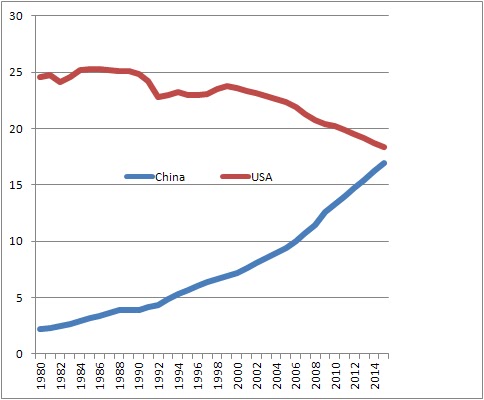
China’s share of world income (measured in purchasing power parity prices) was a mere 2.2 per cent of world income in 1980, rising to 14.4 per cent in 2011, and projected by the IMF to overtake the US by 2016, with 18 per cent.  In 1980, the US share of world income  was 24.6 per cent. In 2011, it was 19.1 per cent. So while the absolute decline of the US share has been mild, its relative decline has been irrefutable. Irrefutable? Step forward Robert Kagan and Barrack Obama!
Share in World GDP_PPP


Robert Kagan’s essay, “The Myth of America’s Decline”, has been seized like a straw by Barrack Obama, according to FT author Edward Luce’ “The Reality of American Decline”.  At the State of the Union on January 26, President Barack Obama argued, "Anyone who tells you that America is in decline or that our influence has waned, doesn't know what they're talking about."  
As for net investment abroad, the switch in world leadership from US to China has been much more impressive. So have its consequences; recommended reading: “The End of Influence: What Happens When Other Countries Have the Money”. But the big risk is that the new US inferiority complex turns the Americans into industry Colbertists, harming the global convergence process underway by interfering with free trade.

 A new paper by Benjamin Mandel of the New York Federal Reserve Bank “Why Is the US Share of World Merchandise Exports Shrinking?” shows that the US share of world merchandise trade dropped from 12 to 8% over the past decade; the respective share for services even dropped from 25 to 6% during the same period.

Both compositional effects and faltering competitiveness explain the delining US share in world exports. The commodities sector was one of the primary drivers of the decline, yet its contribution to export share losses largely derived from the declining weight of commodities in the world export basket as well as the price fl uctuations of these goods. Corn and soybeans were the wrong products to gain market share with in the 1990s, as prices tumbled and income elasticity of food items were low. The growing appetite China’s for protein-rich food may well turn US food exports from laggard to  driver. That said, the United States did experience large declines in share in machinery, transportation products, miscellaneous manufactures, and chemicals.

With such numbers in mind,  President Obama asserted at his recent State of Union address : “We will not go back to an economy weakened by outsourcing.” But: Not outsourcing jobs to locations with lower labour unit cost not only harms the world’s poor but risks losing the jobs withheld in rich countries, too. (Germany’s celebrated competitiveness is quite related to outsourcing of the standardised components of her manufactures). Obama also celebrated manufacturers: “Tonight, I want to speak about an economy that’s built to last - an economy built on manufacturing.” In his “Shame on You, Mr. Obama, for Pandering on Trade”, Professor Jagdish Bhagwati points to the fallacies in Obama’sproposition, and to the risk to the world trading system emanating from the United States:
·         The general disillusionment with the financial sector has been seized on by the manufacturing lobby to argue that therefore manufacturing should be supported. Bhagwati rightly asks: “Why not opt for DHL, transport and communications, for example, instead of cement mixers?”
·         Over time, manufacturing yields to services. This gigantic change that is taking place has nothing to do with outsourcing.
·         The notion that manufacturing is more productive than services is not supported by research. The range of modern services that can be digitised and traded globally is constantly expanding. (India has been a pioneer, but many other poor countries are finding it easier to generate productivity growth in services than in industry.) Services expansion provides an alternative growth escalator.

Watch out when empires start drowning… They might desire to leave the earth scorched.

Wednesday, 25 January 2012

I don’t think we are in Davos anymore

In his celebrated 1984 Brookings paper   “I don’t think we are in Kansas anymore”,  Cuba-born economist Carlos Diaz-Alejandro chose in his title and analogies to place the 1980s international debt crisis in the Land of Oz. As Jeff Sachs pointed out then in his comment, few people realize that the original Wizard of Oz by L. Frank Baum is itself partly an economic parable in which the Wicked Witch of the East represents Eastern capitalists who dehumanize kindly laborers.  And the word OZ was probably constructed by a one-letter transposition of NY, home of those predatory capitalist who played hardball (years before the Brady Plan) with the highly indebted Latin American governments.
At the start of his paper, Diaz-Alejandro announced that hispaper will argue that what could have been a serious but manageable recession has turned into a major development crisis unprecedented since the early 1930s mainly because of the breakdown of international financial markets and an abrupt change in conditions and rules for international ending. The nonlinear interactions between this unusual and persistent external shock and risky or faulty domestic policies led to a crisis of severe depth and length, one that neither shocks nor bad policy alone could have generated. Large capital outflows, in most cases encouraged by unconditional currency convertibility, provided a particularly explosive environment for the interaction of external shocks and imperfect policies”.

 Sounds vaguely familiar, no?

Today, we find ourselves in deep disillusionment with market capitalism, so deep that I get increasingly worried about the “economic consequences of peace”, of attempts to fix the beast by do-it-yourself economists (or, rather, non economists).


Take  Klaus Schwab, the founder of the Davos World Economic Forum (WEF), the arch venue of capitalists and billionnaires who pay big sums to enjoy the Alpine scenery and snow network benefits that the gathering of 2,500+ influential people can bring. (TheDavos WEF was never a place, by contrast, to learn about new ideas or from little known thought leaders; that aspect – intellectual exchange to produce ‘actionable’ concepts – has just been pure decoration, in my judgement). Schwab ahead of the annual meeting: “Capitalism in its current form no longer fits the world around us”.

What is it? Capitalism? In its current form?

Is France capitalist, with a public spending more than half of GDP? Are the United States, a country where contestability and equal access  to, say, education, is severely compromised? The high-growth emerging giants in China and India which are graduating from decades of heavy state intervention? Is it perhaps technology that obviates the need for large-scale employment in sectors other than servisec? Please define, Herr Schwab! What are the alternatives? Communism? Libertarian capitalism? Ordo liberalism? Die Soziale Marktwirtschaft?

In any case, rising evidence of wealth and income inequality in the statistics, partly the result of a long period of Lewis labour markets in China and India that starts to close, the high dose of state intervention in these high-growth countries, their competitive manufacturing industries: all those trends activate polcymakers, especially those with elections coming up.

 
To be sure, today’s problems are severe (and have been made more severe than necessary by people who open this year’s WEF and some of those who attend it). But are these problems inherent to today’s form of market capitalism? Or can they be fixed by monetary and fiscal measures suggested by the Keynesians? What are the alternative economic-model paradigms?

One thing is sure: Don’t expect any insights from Davos. What you will get are tons of familiar buzz words (as ill-defined as ‘capitalism-in-its-current-form’): Inclusive growth; social cohesion; newish,  greenish, skill sources of growth; ‘industrial’ policies to enhance ‘competitiveness’ and ‘innovation’; less private finance and more state capitalism? The list of questions may suffice to alert to the  many risks and traps on the way of the little Kansas girl to the fantasy world.

Monday, 16 January 2012

Boom and Bust and Sovereign Ratings

France joined Austria in losing its top credit rating after government-bond markets closed last week, on Friday 13(!) January.The nations were cut one level to AA+ from AAA and face the risk of further reductions, according to Standard and Poor's, with Moody's and Fitch the world's leading rating agency. While Finland, the Netherlands and Luxembourg kept their AAA ratings, they were put on negative outlook. Spain and Italy were also among the nations downgraded and Portugal was cut two steps to BB. However, on Monday 16 January, French bonds advanced as borrowing costs fell at the nation’s first debt sale since Standard & Poor’s stripped it of its top credit rating and cut the grades of eight other euro-area countries. So what to expect for sovereign risk spreads of the downgraded Europeans against German sovereign risk, holding the euro region’s only stable AAA grade? Further widening, I am afraid.

For what it's worth, let's consult a paper that I wrote with Julia von Maltzan in 1999*, a rating event study exploring the market response for 30 trading days before and after rating announcements. The Figure shows the mean of relative yield spreads before and after 103 rating events. 


In general, the Figure conveys that a change in the risk assessment by the three leading rating agencies is preceded by a similar change in the market’s assessment of sovereign risk. The pattern is particularly clear when countries have been put on review for possible downgrade or upgrade. During the 29 days preceding a review for possible downgrade, relative spreads rise by about 12 percentage points.

For the Euro countries down graded before the weekend another of our result augurs badly, notwithstanding France's successful bond auction today:  Implemented negative rating changes seem to exert a sustained impact on bond yield spreads: the rating downgrade is largely unanticipated. After a country’s rating has been downgraded, the market appears to vindicate the agencies’ assessment over the next 30 trading days with an upward movement in relative yield spreads.

Implement downgrades of emerging-market bonds were shown in our study to produce a strongly significant market reaction: During 30 trading days, from ten days before the press release issued by the rating agency to 20 days thereafter, relative yield spreads widen significantly by an accumulated 12.7 percentage points.

* Helmut Reisen and Julia von Maltzan (1999), "Boom and Bust and Sovereign Ratings", International Finance, Vol.2:2, pp.273-293.

Monday, 9 January 2012

The Tobin tax: can it work (if you stay alone)?

French President Nicolas Sarkozy is due to discuss the Tobin tax today in Berlin over lunch with German Chancellor Angela Merkel. France could table the tax for parliamentary approval next month even if it had to go it alone. Does this make sense? After all, the Swedish experience of introducing a 0.5% transaction tax on the purchase or sale of equities was disappointingly low, despite (or because of) a subsequent doubling of the tax rate. Taxable turnover in equity trading shrank until the tax was discontinued in 1989 from when trading volume recovered. Until further evidence, I retain the scepticism about the revenue potential of the Tobin tax that I expressed ten years ago in the OECD Observer (1). 

 He was against the Tobin tax: James Tobin


Please find some excerpts of what I wrote then: "...the tax was proposed in 1972 by the US economist, James Tobin, as a way of throwing sand in the wheels of international finance, and so combat market volatility. Basically, it would involve taxing currency market transactions. What may explain its appeal to some governments and NGOs is that even a very small tax rate imposed on such a large tax base as the foreign exchange market would, at least in theory, yield sizeable revenues to finance 'global public goods', like the environment, health programmes, poverty reduction, etc. Estimates of between US$50-250bn per year have been waved about, based on tax rates of between 0.05% and 0.25%.

But how realistic are these figures? A look at the structure of currency markets suggests they are probably exaggerated. Currency markets are characterised by a lot of intra-day clearing and netting, a feature likely to be fostered by the growing use of electronic broking....Also, despite the growing role of electronic brokering, trading between dealers (rather than with other financial institutions or with non-financial customers) makes up more than half of foreign exchange market turnover. The largest part of the daily transactions are done for purposes of hedging between traders to avoid over-exposure in currencies accumulated from deal-making. Hedging activities are known as 'hot potato trading', as any speculative selling of, say, the US dollar could leave the seller with a supply of unwanted euros, which he or she will then try to off-load to other dealers. The practice helps to spread risk more evenly. The Tobin tax would discourage hedging, though, because its multiple transactions would each be taxed. Consequently, the tax base of daily foreign exchange transactions would shrink.

There is also the question of how to impose the tax to maximise revenue. Many deals are done throughout a single day and are settled together when the markets close. Taxing these settlement sites where the currencies are transferred to the books of the central banks may seem the simplest approach. However, according to a key study by Professor Peter Kenen (2), the tax should be levied on each trade at the dealing sites. It would then capture the total value of the deals, whereas settlement involves netting the day's transactions, and so would produce a lower taxable amount.
Tax avoidance would probably grow too, further reducing the Tobin tax's ability to yield revenue. Two principal types are likely: first, the migration of the foreign exchange market to tax-free jurisdictions; and second, the substitution of tax-free for taxable transactions.

Migration would occur unless all jurisdictions with major foreign exchange market turnover adopted the tax. Trading could be drawn to new sites, such as an offshore tax haven somewhere. This migration could be prevented by a punitive tax on all transactions with that haven, enabling trading to continue with complying sites. This penalty would reduce the risk of a migration flood gate being opened by a 'first mover'. But it would only work with small jurisdictions. If one of the larger established markets, like Frankfurt or Hong Kong for instance, did not adopt a Tobin tax, plenty of dealers would shift to that tax-free market and trade among themselves, without being affected by any punitive measures. The tax base would clearly be eroded as a result.

To stop substitution of taxable foreign exchange transactions by tax-free ones, the Tobin tax would have to cover several financial instruments and keep up with new ones created to circumvent the tax. For instance, a tax on spot transactions can be avoided easily by using short-dated forward transactions. So, these would have to be taxed as well. And as swap transactions combine a spot with an offsetting forward contract, they would also have to be taxed. Moreover, taxing currency swaps alone will not do, as a foreign exchange transaction can be replicated by a combination of a currency and treasury bill swap, thereby evading the currency market (and the tax) to some extent.
Even assuming the Tobin tax was feasible to operate, would it be economically desirable? Put another way, would it lower distortions in international capital markets and encourage less volatility, or crisis-prone investment and help alleviate poverty?

The original purpose of Mr Tobin's proposal -- to reduce 'excessive' exchange rate volatility -- has moved to the background. After all, the size of the monthly changes in the relative value of key currencies has not grown in line with the rise in international capital mobility of recent decades. On the contrary, as we have seen, the Tobin tax might well reduce the liquidity of foreign exchange markets. And because it reduces hedging activities in the market, it would encourage more pure speculation and hence lead to more, not less, volatility.

Most observers are less concerned with short-term volatility (which can be hedged) than with longer term misalignment of exchange rates, notably those of emerging markets. Such misalignment may at times be rooted in boom-bust cycles of private lending and investment to developing countries. But the Tobin tax would not be large enough to counter these cycles, whose risk-adjusted returns would, given the sudden swings from euphoria to panic, require extremely high tax rates to balance them.

(1) "Tobin Tax: Could It Work?", OECD Observer, No 231/232, May 2002
(2)  Kenen, P., "The Feasibility of Taxing Foreign Exchange Transactions", in The Tobin Tax: Coping with Financial Volatility (M.ul Haq, Inge Kaul, et al, eds.), Oxford, 1996.

Wednesday, 4 January 2012

A New Year's Review to ShiftingWealth 2011

All the best - health, power and prosperity - to you the readers of this blog. Since I started it in April 2011, ShiftingWealth has been viewed more than 6.500 times, not bad a number for an OECD scribbler, I like to think.

The most popular post were (if you want to re-read, just click the link)

Date
Popular Posts 2011
10 April
  5 April
  7 November
25 May
26 September
28 September
  3 May
12 August
18 July
16 November


Where is the audience for this blog? Mostly in advanced countries, with France, United Kingdom, United States and Germany clearly in the lead. Brazil, India and Russia are the frontrunners among the converging countries; China, alas, is not listed as Chinese readers are still forced to enter through foreign web addresses. My wish for 2012? That China allows full internet access. And that this blog makes you rich!