Thursday, 9 February 2012

The Denial of American Decline and the Fetish of Manufacturing

China’s share of world income (measured in purchasing power parity prices) was a mere 2.2 per cent of world income in 1980, rising to 14.4 per cent in 2011, and projected by the IMF to overtake the US by 2016, with 18 per cent.  In 1980, the US share of world income  was 24.6 per cent. In 2011, it was 19.1 per cent. So while the absolute decline of the US share has been mild, its relative decline has been irrefutable. Irrefutable? Step forward Robert Kagan and Barrack Obama!
Share in World GDP_PPP
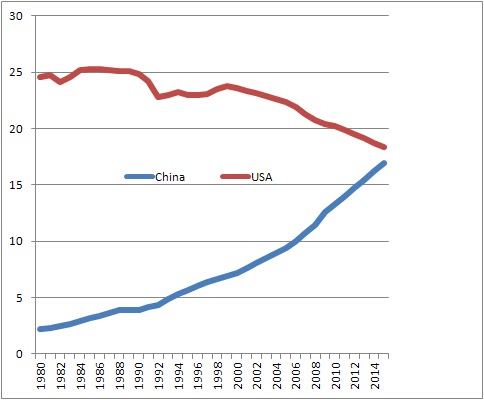

Robert Kagan’s essay, “The Myth of America’s Decline”, has been seized like a straw by Barrack Obama, according to FT author Edward Luce’ “The Reality of American Decline”.  At the State of the Union on January 26, President Barack Obama argued, "Anyone who tells you that America is in decline or that our influence has waned, doesn't know what they're talking about."  
As for net investment abroad, the switch in world leadership from US to China has been much more impressive. So have its consequences; recommended reading: “The End of Influence: What Happens When Other Countries Have the Money”. But the big risk is that the new US inferiority complex turns the Americans into industry Colbertists, harming the global convergence process underway by interfering with free trade.

 A new paper by Benjamin Mandel of the New York Federal Reserve Bank “Why Is the US Share of World Merchandise Exports Shrinking?” shows that the US share of world merchandise trade dropped from 12 to 8% over the past decade; the respective share for services even dropped from 25 to 6% during the same period.

Both compositional effects and faltering competitiveness explain the delining US share in world exports. The commodities sector was one of the primary drivers of the decline, yet its contribution to export share losses largely derived from the declining weight of commodities in the world export basket as well as the price fl uctuations of these goods. Corn and soybeans were the wrong products to gain market share with in the 1990s, as prices tumbled and income elasticity of food items were low. The growing appetite China’s for protein-rich food may well turn US food exports from laggard to  driver. That said, the United States did experience large declines in share in machinery, transportation products, miscellaneous manufactures, and chemicals.

With such numbers in mind,  President Obama asserted at his recent State of Union address : “We will not go back to an economy weakened by outsourcing.” But: Not outsourcing jobs to locations with lower labour unit cost not only harms the world’s poor but risks losing the jobs withheld in rich countries, too. (Germany’s celebrated competitiveness is quite related to outsourcing of the standardised components of her manufactures). Obama also celebrated manufacturers: “Tonight, I want to speak about an economy that’s built to last - an economy built on manufacturing.” In his “Shame on You, Mr. Obama, for Pandering on Trade”, Professor Jagdish Bhagwati points to the fallacies in Obama’sproposition, and to the risk to the world trading system emanating from the United States:
·         The general disillusionment with the financial sector has been seized on by the manufacturing lobby to argue that therefore manufacturing should be supported. Bhagwati rightly asks: “Why not opt for DHL, transport and communications, for example, instead of cement mixers?”
·         Over time, manufacturing yields to services. This gigantic change that is taking place has nothing to do with outsourcing.
·         The notion that manufacturing is more productive than services is not supported by research. The range of modern services that can be digitised and traded globally is constantly expanding. (India has been a pioneer, but many other poor countries are finding it easier to generate productivity growth in services than in industry.) Services expansion provides an alternative growth escalator.

Watch out when empires start drowning… They might desire to leave the earth scorched.

Wednesday, 25 January 2012

I don’t think we are in Davos anymore

In his celebrated 1984 Brookings paper   “I don’t think we are in Kansas anymore”,  Cuba-born economist Carlos Diaz-Alejandro chose in his title and analogies to place the 1980s international debt crisis in the Land of Oz. As Jeff Sachs pointed out then in his comment, few people realize that the original Wizard of Oz by L. Frank Baum is itself partly an economic parable in which the Wicked Witch of the East represents Eastern capitalists who dehumanize kindly laborers.  And the word OZ was probably constructed by a one-letter transposition of NY, home of those predatory capitalist who played hardball (years before the Brady Plan) with the highly indebted Latin American governments.
At the start of his paper, Diaz-Alejandro announced that his “paper will argue that what could have been a serious but manageable recession has turned into a major development crisis unprecedented since the early 1930s mainly because of the breakdown of international financial markets and an abrupt change in conditions and rules for international ending. The nonlinear interactions between this unusual and persistent external shock and risky or faulty domestic policies led to a crisis of severe depth and length, one that neither shocks nor bad policy alone could have generated. Large capital outflows, in most cases encouraged by unconditional currency convertibility, provided a particularly explosive environment for the interaction of external shocks and imperfect policies”.

 Sounds vaguely familiar, no?

Today, we find ourselves in deep disillusionment with market capitalism, so deep that I get increasingly worried about the “economic consequences of peace”, of attempts to fix the beast by do-it-yourself economists (or, rather, non economists).


Take  Klaus Schwab, the founder of the Davos World Economic Forum (WEF), the arch venue of capitalists and billionnaires who pay big sums to enjoy the Alpine scenery and snow network benefits that the gathering of 2,500+ influential people can bring. (TheDavos WEF was never a place, by contrast, to learn about new ideas or from little known thought leaders; that aspect – intellectual exchange to produce ‘actionable’ concepts – has just been pure decoration, in my judgement). Schwab ahead of the annual meeting: “Capitalism in its current form no longer fits the world around us”.

What is it? Capitalism? In its current form?

Is France capitalist, with a public spending more than half of GDP? Are the United States, a country where contestability and equal access  to, say, education, is severely compromised? The high-growth emerging giants in China and India which are graduating from decades of heavy state intervention? Is it perhaps technology that obviates the need for large-scale employment in sectors other than servisec? Please define, Herr Schwab! What are the alternatives? Communism? Libertarian capitalism? Ordo liberalism? Die Soziale Marktwirtschaft?

In any case, rising evidence of wealth and income inequality in the statistics, partly the result of a long period of Lewis labour markets in China and India that starts to close, the high dose of state intervention in these high-growth countries, their competitive manufacturing industries: all those trends activate polcymakers, especially those with elections coming up.

 
To be sure, today’s problems are severe (and have been made more severe than necessary by people who open this year’s WEF and some of those who attend it). But are these problems inherent to today’s form of market capitalism? Or can they be fixed by monetary and fiscal measures suggested by the Keynesians? What are the alternative economic-model paradigms?

One thing is sure: Don’t expect any insights from Davos. What you will get are tons of familiar buzz words (as ill-defined as ‘capitalism-in-its-current-form’): Inclusive growth; social cohesion; newish,  greenish, skill sources of growth; ‘industrial’ policies to enhance ‘competitiveness’ and ‘innovation’; less private finance and more state capitalism? The list of questions may suffice to alert to the  many risks and traps on the way of the little Kansas girl to the fantasy world.

Monday, 16 January 2012

Boom and Bust and Sovereign Ratings

France joined Austria in losing its top credit rating after government-bond markets closed last week, on Friday 13(!) January.The nations were cut one level to AA+ from AAA and face the risk of further reductions, according to Standard and Poor's, with Moody's and Fitch the world's leading rating agency. While Finland, the Netherlands and Luxembourg kept their AAA ratings, they were put on negative outlook. Spain and Italy were also among the nations downgraded and Portugal was cut two steps to BB. However, on Monday 16 January, French bonds advanced as borrowing costs fell at the nation’s first debt sale since Standard & Poor’s stripped it of its top credit rating and cut the grades of eight other euro-area countries. So what to expect for sovereign risk spreads of the downgraded Europeans against German sovereign risk, holding the euro region’s only stable AAA grade? Further widening, I am afraid.

For what it's worth, let's consult a paper that I wrote with Julia von Maltzan in 1999*, a rating event study exploring the market response for 30 trading days before and after rating announcements. The Figure shows the mean of relative yield spreads before and after 103 rating events. 


In general, the Figure conveys that a change in the risk assessment by the three leading rating agencies is preceded by a similar change in the market’s assessment of sovereign risk. The pattern is particularly clear when countries have been put on review for possible downgrade or upgrade. During the 29 days preceding a review for possible downgrade, relative spreads rise by about 12 percentage points.

For the Euro countries down graded before the weekend another of our result augurs badly, notwithstanding France's successful bond auction today:  Implemented negative rating changes seem to exert a sustained impact on bond yield spreads: the rating downgrade is largely unanticipated. After a country’s rating has been downgraded, the market appears to vindicate the agencies’ assessment over the next 30 trading days with an upward movement in relative yield spreads.

Implement downgrades of emerging-market bonds were shown in our study to produce a strongly significant market reaction: During 30 trading days, from ten days before the press release issued by the rating agency to 20 days thereafter, relative yield spreads widen significantly by an accumulated 12.7 percentage points.

* Helmut Reisen and Julia von Maltzan (1999), "Boom and Bust and Sovereign Ratings", International Finance, Vol.2:2, pp.273-293.

Monday, 9 January 2012

The Tobin tax: can it work (if you stay alone)?

French President Nicolas Sarkozy is due to discuss the Tobin tax today in Berlin over lunch with German Chancellor Angela Merkel. France could table the tax for parliamentary approval next month even if it had to go it alone. Does this make sense? After all, the Swedish experience of introducing a 0.5% transaction tax on the purchase or sale of equities was disappointingly low, despite (or because of) a subsequent doubling of the tax rate. Taxable turnover in equity trading shrank until the tax was discontinued in 1989 from when trading volume recovered. Until further evidence, I retain the scepticism about the revenue potential of the Tobin tax that I expressed ten years ago in the OECD Observer (1). 

 He was against the Tobin tax: James Tobin


Please find some excerpts of what I wrote then: "...the tax was proposed in 1972 by the US economist, James Tobin, as a way of throwing sand in the wheels of international finance, and so combat market volatility. Basically, it would involve taxing currency market transactions. What may explain its appeal to some governments and NGOs is that even a very small tax rate imposed on such a large tax base as the foreign exchange market would, at least in theory, yield sizeable revenues to finance 'global public goods', like the environment, health programmes, poverty reduction, etc. Estimates of between US$50-250bn per year have been waved about, based on tax rates of between 0.05% and 0.25%.

But how realistic are these figures? A look at the structure of currency markets suggests they are probably exaggerated. Currency markets are characterised by a lot of intra-day clearing and netting, a feature likely to be fostered by the growing use of electronic broking....Also, despite the growing role of electronic brokering, trading between dealers (rather than with other financial institutions or with non-financial customers) makes up more than half of foreign exchange market turnover. The largest part of the daily transactions are done for purposes of hedging between traders to avoid over-exposure in currencies accumulated from deal-making. Hedging activities are known as 'hot potato trading', as any speculative selling of, say, the US dollar could leave the seller with a supply of unwanted euros, which he or she will then try to off-load to other dealers. The practice helps to spread risk more evenly. The Tobin tax would discourage hedging, though, because its multiple transactions would each be taxed. Consequently, the tax base of daily foreign exchange transactions would shrink.

There is also the question of how to impose the tax to maximise revenue. Many deals are done throughout a single day and are settled together when the markets close. Taxing these settlement sites where the currencies are transferred to the books of the central banks may seem the simplest approach. However, according to a key study by Professor Peter Kenen (2), the tax should be levied on each trade at the dealing sites. It would then capture the total value of the deals, whereas settlement involves netting the day's transactions, and so would produce a lower taxable amount.
Tax avoidance would probably grow too, further reducing the Tobin tax's ability to yield revenue. Two principal types are likely: first, the migration of the foreign exchange market to tax-free jurisdictions; and second, the substitution of tax-free for taxable transactions.

Migration would occur unless all jurisdictions with major foreign exchange market turnover adopted the tax. Trading could be drawn to new sites, such as an offshore tax haven somewhere. This migration could be prevented by a punitive tax on all transactions with that haven, enabling trading to continue with complying sites. This penalty would reduce the risk of a migration flood gate being opened by a 'first mover'. But it would only work with small jurisdictions. If one of the larger established markets, like Frankfurt or Hong Kong for instance, did not adopt a Tobin tax, plenty of dealers would shift to that tax-free market and trade among themselves, without being affected by any punitive measures. The tax base would clearly be eroded as a result.

To stop substitution of taxable foreign exchange transactions by tax-free ones, the Tobin tax would have to cover several financial instruments and keep up with new ones created to circumvent the tax. For instance, a tax on spot transactions can be avoided easily by using short-dated forward transactions. So, these would have to be taxed as well. And as swap transactions combine a spot with an offsetting forward contract, they would also have to be taxed. Moreover, taxing currency swaps alone will not do, as a foreign exchange transaction can be replicated by a combination of a currency and treasury bill swap, thereby evading the currency market (and the tax) to some extent.
Even assuming the Tobin tax was feasible to operate, would it be economically desirable? Put another way, would it lower distortions in international capital markets and encourage less volatility, or crisis-prone investment and help alleviate poverty?

The original purpose of Mr Tobin's proposal -- to reduce 'excessive' exchange rate volatility -- has moved to the background. After all, the size of the monthly changes in the relative value of key currencies has not grown in line with the rise in international capital mobility of recent decades. On the contrary, as we have seen, the Tobin tax might well reduce the liquidity of foreign exchange markets. And because it reduces hedging activities in the market, it would encourage more pure speculation and hence lead to more, not less, volatility.

Most observers are less concerned with short-term volatility (which can be hedged) than with longer term misalignment of exchange rates, notably those of emerging markets. Such misalignment may at times be rooted in boom-bust cycles of private lending and investment to developing countries. But the Tobin tax would not be large enough to counter these cycles, whose risk-adjusted returns would, given the sudden swings from euphoria to panic, require extremely high tax rates to balance them.

(1) "Tobin Tax: Could It Work?", OECD Observer, No 231/232, May 2002
(2)  Kenen, P., "The Feasibility of Taxing Foreign Exchange Transactions", in The Tobin Tax: Coping with Financial Volatility (M.ul Haq, Inge Kaul, et al, eds.), Oxford, 1996.

Wednesday, 4 January 2012

A New Year's Review to ShiftingWealth 2011

All the best - health, power and prosperity - to you the readers of this blog. Since I started it in April 2011, ShiftingWealth has been viewed more than 6.500 times, not bad a number for an OECD scribbler, I like to think.

The most popular post were (if you want to re-read, just click the link)

Date
Popular Posts 2011
10 April
  5 April
  7 November
25 May
26 September
28 September
  3 May
12 August
18 July
16 November


Where is the audience for this blog? Mostly in advanced countries, with France, United Kingdom, United States and Germany clearly in the lead. Brazil, India and Russia are the frontrunners among the converging countries; China, alas, is not listed as Chinese readers are still forced to enter through foreign web addresses. My wish for 2012? That China allows full internet access. And that this blog makes you rich!

Friday, 2 December 2011

The Renminbi and Poor-Country Growth

China’s current account surplus over the recent two decades can be well explained by structural savings determinants.  Song, Storesletten and Zilibotti (2010)[1] have have stressed the role of rising corporate savings due to reallocation within the manufacturing sector from low- to high-productivity companies. Wei (2010)[2] explains rising China’s household savings with gender-imbalances. Still, large appreciations do impact the current account and - in developing countries -  do depress growth (Keppler, Reisen, Schularick and Turkisch, 2011)[3], as evidenced by data over the past fifty years.


Renminbi effective exchange rate index, 2008 - 2011
Source: BIS


The graph documents the appreciation of the renminbi (RMB) in nominal (red dashed line) and real (blue solid line) effective exchange rate (REER) based on broad BIS effective exchange rate indices, comprising trade weights with 58 economies. Mostly due to positive inflation differentials with its trade partners, China’s currency has appreciated by 18 percent compared with its trade partners[4]  since 2008.  

What does the recent RMB appreciation mean for low- and middle-income countries countries? That, indeed, is a question rarely raised, and opinions rather than hard evidence have been provided. Subramanian (2010)[5] seems to envisage a static world economy where “higher tradable goods production in China results in lower traded goods production elsewhere in the developing world, entailing a growth cost for these countries”. While China’s undervaluation has boosted its long-run growth rate (by more than 2 per cent, according to Rodrik, 2008[6]) by allowing greater output of tradable goods, Subramanian juxtaposes the other poor countries as “emerging market victims” of China’s exchange rate policy. Rodrik (2010)[7] agrees: “China’s currency policies not only undercut the competitiveness of African and other poor regions’ industries; they also undermine those regions’ fundamental growth engines. What poor nations get out of Chinese mercantilism is, at best, temporary growth of the wrong kind.” Rodrik is concerned that countries in Sub-Saharan Africa, in particular, have been propelled forward merely by the growing demand for their natural resources from other countries – especially from China.

So is the recent RMB appreciation good news for other poor countries?   Now, with the RMB having gained in real effective terms by more than a quarter since mid 2005 (see graph), poor countries’ exports surely have become more competitive, which should speed growth if Subramanian and Rodrik are correct. “The Renminbi and Poor-country Growth”, a new publication[8], suggests the contrary – provided RMB appreciation will produce a slowdown in China’s growth as predicted by Kappler et al (2011) for the group of developing countries.

To analyse the impact of China’s growth (slowdown) on a broad group of poor  countries, the paper looks  at the relationship between China’s growth rate and those of 115 developing and emerging countries for the period between 1990 and 2009. The analysis distinguishes net oil and raw material exporters from net importers, and low- income from middle-income developing countries. The impact of China’s growth on these four country groups can be quantified using a fixed-effects model, which allows to analyse a cross-section of developing countries over time.

Some results of the series of panel regressions  deserve to be noted, including by politicians:

1.       The impact of China’s growth on both the low- and middle-income countries has grown significantly in the 2000s. The results show that a one per cent change in China’s growth rates will result in a change around 0.34 per cent in the same direction in the low-income countries. As for the middle-income countries, the corresponding growth association is 0.66 per cent.
2.       Similar to Levy Yeyati (2009)[9], the impact of OECD countries is found to have significantly decreased over the same period for the low-income countries with a coefficient close to zero (0.03 per cent to be precise). As for the middle-income countries though, there has not been a significant decrease in the impact of OECD growth in the 2000s.
3.       The results of the export-based analysis show that the China impact is not limited to exporters of oil and raw materials. On the contrary, the increasing growth association with China in the 2000s is a robust finding that pertains to non-oil developing countries. Consequently, China’s strengthening growth engine role for poor countries is not merely driven by the its demand for oil and other raw materials. This finding is supported by growing evidence of the remarkable rise of manufactured exports from Sub-Saharan Africa to China and other emerging countries and by foreign direct investment from emerging countries that has reached Africa’s non-oil countries (in proportion to their respective GDP) not less than it reached oil and raw material producers; by contrast, OECD-country imports from Africa remains as biased towards oil as the FDI flows from OECD to Africa.[10].

The trade patterns of growing countries tend to be quite dynamic. If factors are being accumulated at differential rates, the composition of output can change quite quickly. Rybczynski effects suggest that China’s skill-intensive output is rising disproportionately. Unlike low-income countries that do not compete directly with China anymore, advanced and middle-income manufacturing exporters compete directly with China in manufacturing exports. As a result, they are likely to gain the most from RMB revaluation. China’s average export prices (unit values) place substantial downward pressure on these countries’ prices; by contrast, there is little and melting evidence for price competition between China and low-income countries[11]. Table 3 summarises the discussion and the potential growth impact of renminbi for low- and middle-income countries[12].

The potential growth impact of renminbi appreciation on developing countries
Impact channel
Growth effect
Price effect
Total effect
Country group


Low-income, oil & non-oil
Negative
Insignificant
Negative
Middle-income, oil & non-oil
Negative
Positive
Ambiguous
Source: See discussion in text based on own estimates; Rodrik (2008); Levy-Yeyati (2009) and Fu et al. (2010).

Considering the evidence on the lack of export competition between China and poor countries and their dependence on China’s growth for their own growth performance, the growth impact for poor countries of a sudden and perhaps ‘excessive’ renminbi appreciation would be likely to be negative. The growth impact on middle-income countries would be ambiguous, as the negative engine effect of a slowdown in China’s growth might be compensated through increased competitiveness that resource-poor middle-income countries would enjoy as a result of an appreciated renminbi. By extension, therefore, not just China but likewise other poor countries – in particular those which now have a low index of export similarity with China – have a vested interest in China’s exchange rate to remain conducive to growth.

If China continues to converge towards advance-country per capita income levels, either higher real wages or real appreciation of the Chinese currency will continue to speed China’s structural upgrading. This would further soften the price pressures on low-skilled goods and on low-income countries. At the same time, technological upgrading in China would move China’s price impact from the middle-income countries to the high-income economies. Prosperity in China and other large emerging countries will improve export opportunities for the remaining developing countries, which can lead to accelerating global growth, supported by a demographic transition with a drop in fertility and young age dependence[13]. China’s initial opening may have hurt some developing countries in the 1990s, but its sustained growth improves the long-term prospects of low-income developing countries.


[1] Song, Z., Storesletten, K., and F. Zilibotti (2010), The “Real” Causes of China’s Trade Surplus, VoxEu.org, 2 May.
[2] Wei, S-J (2010), The Mystery of China’s Savings, VoxEu.org, 6 February.
[3] Kappler, M, H. Reisen, M. Schularick and E. Turkisch (2011), The Macroeconomic Effects of Large Currency Appreciations, OECD Development Centre Working Papers No. 296.
[4] In an earlier VoxEu article, I had estimated the renminbi to be undervalued by 12 percent relative to the Balassa-Samuelson benchmark that allows for differences in per capita incomes;  Reisen, H. (2009), How to assess the renminbi’s undervaluation, VoxEu.org, 17 December.
[5] Subramanian, A. (2010), It is the poor who pay for the weak renminbi, , Financial Times, 3 February.
[6] Rodrik, D (2008), “The Real Exchange Rate and Economic Growth”, Brookings Papers on Economic Activity, Vol. 2.
[8] Garroway, C., Hacibedel, B., Reisen, H. and E. Turkisch (2011), “The Renminbi and Poor-country Growth”, The World Economy, Vol 34, Issue 11, November
[9] Levy Yeyati, E. (2009), On emerging markets decoupling and growth convergence, VoxEu.org, 7 November.
[10] For detailed evidence,  see the African Economic Outlook 2011, www.africaneconomicoutlook.com.
[11] Fu, X, Kaplinsky, R., and J. Zhang (2010), “The Impact of China’s Exports on Global Manufactures Prices”, Universty of Oxford. SLPTMD Working Paper 32.
[12] This is obviously a very broad summary of likely effects which does not do justice to country situations. For example, the net growth effect for resource-rich middle-income countries is likely to resemble the negative impact that a real effective appreciation of the renminbi would have on lowincome countries. However, the empirical evidence presented in the literature reviewed does not allow further country disaggregation.
[13] See Chamon and M., Kremer, M. (2009),  Economic transformation, population growth and the long-run world income distribution, Journal of International Economics, Vol79.1., September.